For Iron Man, who breaks steel with his bare hands. I wish you the best at Liberty.
Something Happened, And It Was A Big Deal
Most people who express their thoughts on Jesus believe he was a great person, an excellent teacher, full of thoughtful comments, and did a lot of good. But the guy was running around saying he was God.
He was either God, one of history’s biggest liars, or someone who was just crazy. Because of the empty tomb, he has had more impact on our world than anyone else in history.
Let’s look at the evidence in a logical, organized way.
Inductive Historical Evidence
Antiquity
Does Jesus of Nazareth Deserve Historical Investigation?
Does Jesus, a figure of antiquity, deserve serious intellectual investigation? If one demands 100% certainty, history will always disappoint. Absolute proof belongs to mathematics and alcohol. Historical inquiry operates through probability and inductive reasoning. The proper question is not whether Jesus can be proven with certainty, but whether the available evidence justifies belief using standard historical methodology.¹
Ancient history presents obvious limitations: there are no video recordings, no audio documentation, no opportunity to interrogate eyewitnesses, and limited surviving materials. Because of these constraints, historians rely on inductive reasoning—drawing probable conclusions from converging lines of evidence.²
Widely Accepted Historical Starting Points
A broad range of scholars—Christian, Jewish, agnostic, and atheist—generally agree on several foundational claims:
- Jesus of Nazareth lived and was crucified under Pontius Pilate.³
- Shortly after his death, his disciples sincerely believed they had seen him alive.⁴
- The resurrection message was proclaimed very early: within five years of the resurrection.⁵
- James, the brother of Jesus and formerly skeptical, became a leader in the movement.⁶
- Paul, originally a persecutor of Christians, converted after what he believed was an appearance of the risen Jesus.⁷
These claims serve as historical data points requiring explanation.
Hume and the Question of Miracles
David Hume argued:
Premise 1: The laws of nature are established by uniform human experience.
Premise 2: A miracle contradicts uniform human experience.
Conclusion: Therefore, testimony for a miracle will always be outweighed by evidence for the laws of nature.⁸
The challenge with this reasoning is methodological. If “uniform experience” is defined in a way that excludes miracles from the outset, then no amount of testimony could ever count in favor of one. It is a logical fallacy, specifically circular reasoning.⁹ A more neutral historical approach asks: Given the evidence, which explanation best accounts for the data?
Argument 1: Inference to the Best Explanation
P1: The explanation that accounts for the relevant historical facts with the fewest ad hoc assumptions should be preferred.¹⁰ ( ad hoc refers making up information specifically to fill in information)
P2: The resurrection hypothesis explains the early proclamation, the sincerity of the disciples, the conversion of skeptics, reports of an empty tomb, and the rapid emergence of Christianity.¹¹
C: Therefore, the resurrection hypothesis is a strong explanatory candidate.
This is an inductive conclusion, not a deductive one.
Argument 2: The Sincerity of the Disciples
P1: People may suffer for what they believe is true, but not for what they know to be false.
P2: The earliest disciples endured persecution for proclaiming the resurrection.¹²
C: Therefore, they sincerely believed their claim.
This does not establish that the resurrection occurred, but it undermines the theory that the disciples knowingly fabricated the story.
Argument 3: The Empty Tomb
P1: If Jesus’ body had remained publicly accessible in the tomb, resurrection claims could have been easily falsified.
P2: The resurrection was proclaimed in Jerusalem, and no body was produced to refute the claim.¹³
C: Therefore, it is historically plausible that the tomb was empty.
Alternative explanations—such as survival, theft, or mistaken location—require additional assumptions and face historical difficulties.¹⁴
Argument 4: Eyewitness Testimony
Early sources report multiple claimed appearances:
- Women as the first witnesses¹⁵
- Appearances to the disciples
- An appearance to James
- An appearance to Paul
- A reported appearance to more than 500 individuals (1 Corinthians 15:3–8)¹⁶
Most scholars date the creed in 1 Corinthians 15 to within a few years of the crucifixion.¹⁷
P1: Early, multiple, and independent testimony increases historical probability.
P2: The resurrection reports meet these criteria.
C: Therefore, the testimony requires explanation.
Hallucination theories may account for individual experiences but struggle to explain repeated group appearances, the conversion of skeptics, and the emergence of a unified resurrection proclamation.¹⁸
Cumulative Inductive Conclusion
Individually, each argument is open to debate. However, when considered cumulatively—early proclamation, sincere witnesses, conversion of skeptics, and the rapid formation of a resurrection-centered movement—the resurrection emerges as a coherent explanatory hypothesis.
This conclusion is probabilistic. It does not claim certainty. Rather, it asserts that, given the historical data, the resurrection remains a serious explanatory option, particularly if one does not rule out the possibility of divine action in advance.¹⁹
Footnotes
- C. Behan McCullagh, Justifying Historical Descriptions (Cambridge: Cambridge University Press, 1984).
- Richard Swinburne, The Concept of Miracle (London: Macmillan, 1970).
- Bart D. Ehrman, Did Jesus Exist? (New York: HarperOne, 2012).
- Gerd Lüdemann, The Resurrection of Jesus (Minneapolis: Fortress Press, 1994).
- James D. G. Dunn, Jesus Remembered (Grand Rapids: Eerdmans, 2003).
- E. P. Sanders, The Historical Figure of Jesus (London: Penguin, 1993).
- Paula Fredriksen, From Jesus to Christ (New Haven: Yale University Press, 2000).
- David Hume, An Enquiry Concerning Human Understanding, Section X.
- John Earman, Hume’s Abject Failure (Oxford: Oxford University Press, 2000).
- Peter Lipton, Inference to the Best Explanation (London: Routledge, 2004).
- N. T. Wright, The Resurrection of the Son of God (Minneapolis: Fortress Press, 2003).
- Larry Hurtado, Lord Jesus Christ (Grand Rapids: Eerdmans, 2003).
- William Lane Craig, Assessing the New Testament Evidence for the Historicity of the Resurrection (Lewiston: Edwin Mellen, 1989).
- Dale C. Allison Jr., Resurrecting Jesus (New York: T&T Clark, 2005).
- Raymond E. Brown, The Death of the Messiah (New York: Doubleday, 1994).
- 1 Corinthians 15:3–8 (widely recognized as containing early creedal material).
- James D. G. Dunn, “1 Corinthians 15:3–8 as Tradition,” in Jesus and the Spirit (Philadelphia: Westminster, 1975).
- Dale C. Allison Jr., The Resurrection of Jesus: Apologetics, Polemics, History (London: Bloomsbury, 2021).
- Richard Swinburne, The Resurrection of God Incarnate (Oxford: Oxford University Press, 2003).
Evidence for the Ressurection
Religions of the World

There are many religions in the world, each with its own set of beliefs, practices, and traditions. Some of the major religions include Christianity, Islam, Hinduism, Buddhism, and Judaism.
MEEET
an acronym for the ressurection
The Resurrection: Examining the Witnesses
Watching the popular series The Chosen presents a compelling portrayal of the life of Jesus and His apostles as they gather, work together, and grow close during the early days of His ministry. A group of devoted women also followed Him. They witnessed extraordinary miracles: water turned into wine, the blind receiving sight, the lame walking, and even a man raised from the dead. It must have seemed like a remarkable journey to be part of. Then everything changed.
On a dreadful Friday, Jesus was crucified. Hope and excitement vanished. Their Rabbi was brutally executed. His back was torn by scourging. He was mocked and beaten, and He carried a heavy cross before being nailed to it. Within six hours, He died. To confirm His death, a soldier pierced His side, and blood and water flowed from the wound. His body was placed in a tomb owned by Joseph of Arimathea, a member of the Sanhedrin.
For the apostles, the ministry for which they had sacrificed everything appeared to be over. They retreated to an upper room, overwhelmed and defeated. What now? How does one rebuild a life after such devastation?
On the third day, several women went to the tomb intending to anoint His body with spices. Mary Magdalene arrived and found the stone rolled away. The tomb was empty. Shock and confusion followed. Had someone taken the body? Had the suffering not been enough?
Yet that Sunday changed everything. Mary encountered a man who called her by name. When she heard her name, she recognized Him—it was Jesus. She ran to tell Peter and John. They, too, found the tomb empty. Soon, Jesus appeared to the other women, to Peter, to the eleven apostles, to a group of more than 500 people, to James, and finally to Paul.
If these claims are to be examined seriously, the witnesses must be examined carefully.
Multiple Eyewitnesses
On several occasions, Jesus appeared to groups of people, including one gathering of more than 500 individuals at the same time. About twenty years later, Paul recorded this in writing, noting that many of those witnesses were still alive and able to challenge the claim if it were false.
Some skeptics suggest the possibility of mass hallucination. However, folie à deux describes a rare psychological condition in which two closely associated individuals share a delusion. Extending such a phenomenon to 500 people simultaneously stretches credibility.
Embarrassing Details
People who fabricate a story typically avoid including details that would weaken their case. In first-century Jewish culture, women’s testimony was considered unreliable in court. Yet the Gospels report that women were the first to discover the empty tomb.
If someone were inventing a resurrection story, it would have been far more persuasive to name respected male leaders as the primary witnesses. Instead, the narrative includes an element that would have been culturally embarrassing—suggesting authenticity rather than invention.
Early Accounts
In historical analysis, the time gap between an event and its written record is critical. Within a few years of the resurrection, Paul visited Peter and James in Jerusalem (Galatians 1:18). In 1 Corinthians 15:3–8, Paul records a creed that most scholars date to within two to five years of the crucifixion.
The passage states:
“For what I received I passed on to you as of first importance: that Christ died for our sins according to the Scriptures, that he was buried, that he was raised on the third day according to the Scriptures, and that he appeared to Cephas, and then to the Twelve…”
The rhythmic structure suggests this was an early memorized creed circulated orally before Paul recorded it. Dating a 2,000-year-old event to within a few years of its occurrence is remarkable, and many scholars acknowledge the early origin of this testimony.
Enemy Attestation
Paul was not initially a follower of Jesus. He actively persecuted Christians, imprisoning and even participating in their deaths. He had status, authority, and security within Jewish leadership. There was no clear benefit for him to fabricate a resurrection claim. His conversion cost him everything and ultimately led to his execution.
James, the brother of Jesus, was also initially skeptical. During Jesus’ ministry, His family did not fully understand or support Him. Yet James later became a leader in the Jerusalem church and was martyred for his belief. Such transformations demand explanation.
The Transformation of the Disciples
Before the resurrection, the disciples were hiding in fear. After claiming to see the risen Jesus, they became bold and public in their proclamation. They spread their message across regions despite persecution.
People may die for something they sincerely believe to be true, but they rarely die for what they know to be a lie. The disciples gained no wealth, power, or comfort from their testimony. Instead, most suffered, and many were executed.
Their transformation remains one of the most compelling pieces of evidence.
How Do You Explain the Resurrection?
A story like this demands checking into and an explanation. This started immediately and below are considered. What does the evidence say?
- The conspiracy theory
- The apparent death theory
- The displaced body theory
- The hallucination theory
Site Content
Nearly all Biblical Scholars agree on these 5 historical events
- Jesus was crucified and died on the cross.
- The tomb where Jesus was buried was empty.
- Apostle Paul believed he saw the risen Jesus.
- James, the half-brother of Jesus, believed he saw the risen Jesus.
- The 11 Apostles believed they saw the risen Jesus.
- Over 500 people claimed to see the resurrected Jesus at one time.
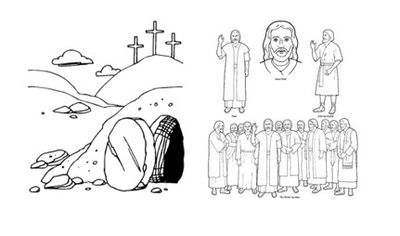
Note the illustration on the left.
