Christianity: the last respectable bigotry in the U.S.

Whoopi's Whopper
I was sitting at a desk while working in a large office with two young atheists, talking about all of the problems and struggles in the world that were due to religion. To me, they seemed right because they spoke with confidence and mentioned the Crusades and the witches in Massachusetts. I didn’t say a word because I had heard these kinds of stories for most of my life.
It was time for me to check it out myself. Type in "Hitler was a Christian", and discover over 5 million search results. At the same time, discovering that Stalin, Mao, Hitler, and Pol Pot were deeply religious. Many articles claimed Hitler and the others were very religious, and did so with confidence, boldness, and anger toward a God that to them did not exist.
How do people come up with such unfounded and erroneous beliefs? It is based on ignorance, an inability to understand different writing approaches and cultures, and the use of a variety of logical fallacies.
Almost all the time, they have a blind spot bias, very little knowledge of Christianity, the Bible, or any other religion. With respect to the Bible, unaware of different writing genres, techniques, and styles, including historical, poetic, letters, and wisdom literature. Seemingly unaware of the difference between parables and true stories. Also, unaware of the cultural differences between thousands of years ago and today.
Numerous logical fallacies were used, including cherry picking, contextomy, equivocation, definist, and guilt by association. Although definist is not often used in our world today it is used constantly when smearing Christianity.
. I found such topics were based on guilt by association, cherry picking, contextomy, false information, and lies. Surprisingly, as horrible as the just mentioned people were, they had a mother. Research them and find that most of the mothers at some point in there lives went to some religious activity. That is all some need as proof that psychopathic leader was very religious.
A
The Donovan Nuremberg Trials Collection consists of nearly 150 bound volumes of Nuremberg trial transcripts and documents from the personal archives of General William J. Donovan (1883-1959). The Donovan papers contain both original statements from the defendants in German and typed translations in English prepared by the Allies.
The Donovan Archive is a voluminous collection of material related to the first Nuremberg Trials of 1945-1946 and comprises investigative, procedural, and legal documents. The documents assume various formats, ranging from mimeographs, photostats, and carbon copies to photographs, maps, typescripts, and original manuscripts. While many of the documents are copies that can be found elsewhere, there are a significant number that are unique to Cornell's holdings and that represent an important part of the history of the Nuremberg process.
I have spent many hours reviewing the cornell University online library of the nuremberg trial. There are around 4.000 are available and you may view them as I did (not all 4000. these were collected and stored in a 42-volume set. Unfortunately, they were kept secret.
https://digital.library.cornell.edu/collections/nuremberg
Hitler delivered approximately 1,000 speeches throughout his career, often lasting one and a half to two hours each, resulting in millions of words spoken. While exact, comprehensive word counts for the entirety of his spoken rhetoric are not readily available, about 800 of his speeches have survived in written form.  Amazon.com +1
- Total Speeches: Roughly 1,000.
- Surviving Speeches: Nearly 800, mostly in printed form from the Völkischer Beobachter newspaper.
- Audio Recordings: Around 300 speeches are preserved as audio files.
- Style: Speeches were characterized by long durations and simple language. Amazon.com +1
For a full collection of his speeches, the book "My New Order" is a commonly cited, comprehensive source. Amazon.com +1
- My New Order A Collection of Speeches by Adolph Hitler ...They use a low form of language, with simple sentences even a person with the lowest level of education or with no education at al...Amazon.com

- Putting Hitler research on a new footing - Goethe-Universität FrankfurtMay 15, 2024 — There is, after all, a vast amount of material: Almost 800 of Adolf Hitler's speeches have survived, most of them in printed form ...
 Goethe-Universität Frankfurt
Why would I choose Hitler to show the mythical relationship between religion and violence? There are several reasons. First, he is so well known, and many people have unwavering beliefs in his honesty and theological knowledge. .Google the phrase "Hitler was a Christian," and you get a return of 56,000.000 sites. Do the same for Billy Graham and get a little less than half of that number.
The poor reasoning or fallacies used to classify Hitler as a Christian are same fallacies used to classify many crazies as Christians. The following fallacies are the most common for associating religion with violence : underlying cause, dunning Kruger, blind spot bigotry, appeal to celebrity, equivocation fallacy, guilt by association, genetic fallacy, and cherry-picking.
Several generations have passed since Hitler died of lead poisoning (a loaded pistol is an excellent administrative device for such a horrible human). Several generations are enough time for myths to crop up, and much information was kept secret until 2017. It seems it was kept confidential to protect the guilty.Today, however, we have over 150 bound volumes of information related to the Nuremberg Trial that was kept secret until 2017. Much of this website is based on that information.
Soulful Faith
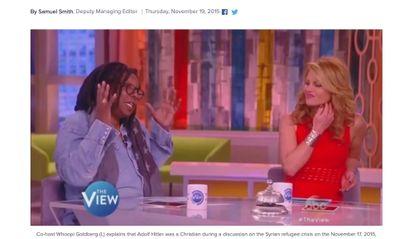
Whoopi's whopper and Joy's Jumble
Whoopi’s Whopper and Joy’s Jumble
On The View, Whoopi Goldberg in 2015 made a startling claim, suggesting that Christian refugees could be just as dangerous as ISIS. She argued that “there have been a lot of horrifying... a lot of monster Christians. Hitler was a Christian.” When some viewers appeared confused, she clarified her statement, saying, “He didn’t like Catholics, remember? So he thought of himself as a Christian.” This line of reasoning, though shocking, is not uncommon in some online circles. But is this logic sound?
Let’s break down her argument:
Premise 1: Hitler didn’t like Catholics.
Premise 2: Christians didn’t like Catholics.
Conclusion: Therefore, Hitler was a Christian.
While it’s true that Hitler despised Catholics, he also hated a long list of other groups, including Christians (in general), Jehovah’s Witnesses, people with disabilities, Jews, the French, the British, Americans, Polish people, nuns, priests, and atheists. The “atheists” at the time referred to themselves as “free thinkers.”Hitler did not want free thinkers. The claim that Hitler was a Christian, based on his hatred for Catholics alone, is a weak premise.
Premise 2: Ninety percent of Germany was Christian, and out of that, about 30% were Catholic. These groups coexisted peacefully before Hitler’s rise to power. Additionally, Hitler’s own mother was Catholic, and he was never recorded as expressing hatred for her. If both premises were accurate, the argument could be reasonable, but they are not.
Now, let’s look at Joy Behar’s statement: “Timothy McVeigh was a Christian. Just saying.” Behar, like many celebrities, often expresses bold opinions. Her justification for this claim is that McVeigh was baptized and attended church as a boy. However, McVeigh’s religious beliefs as an adult were far from Christian. He never identified with any faith as he grew older and even expressed contempt for organized religion.
The problem with both of these celebrity statements is that they oversimplify complex historical and personal issues. They rely on weak premises and logical fallacies, all while ignoring critical context. In the end, being baptized or having a passing association with a religion doesn’t make one a representative of that faith, and it certainly doesn’t justify making broad, inflammatory claims.
The fallacies in Whoopi’s argument are clear:
- Singular Cause Fallacy: Christianity isn’t based on a single cause or belief. Hitler’s view of religion was far more complex and cannot be reduced to a mere rejection of Catholicism.
- Unreasonable Inclusion Fallacy is the most prevalent fallacy when identifying Christians as really bad people. Unfortunately, few people know the basic tenets of Christianity and therefore can include anything and everything as a Christian. The tenets of Christianity are expressed in the acronym S sin separates us from God, A atonement through Christ’s sacrifice, V virgin birth shows the deity of Christ, E eternal life offered by Grace, D decision to accept Jesus as Lord. Notice that disliking Catholics is not included as a Christian tenet.
- Contextomy: While it’s true that Hitler hated Catholics, this argument ignores the broader context: he hated many different groups, and any consistent religious doctrine did not drive his actions.
- Cherry-picking: In a 1922 speech, Hitler said, “My feeling as a Christian points me to my Lord and Savior as a fighter. It points me to the man who once in loneliness, surrounded by a few followers, recognized these Jews for what they were and summoned men to fight against them, and who, God’s truth! was greatest not as a sufferer but as a fighter.” (April 12, 1922). Hitler, as a young politician, needed Catholic and Christian support. Of the over 800 speeches, each lasting one to one and a half hours, he did not refer to himself as Christian again. He did refer to the Almighty Creator and work of the Lord frequently; he was not an atheist, and he believed providence chose him to save the world from Jews like Jesus.
- Equivocation Fallacy: It includes numerous hate groups in Christianity. Hitler did not believe in the virgin birth (Jesus’ father was a Roman soldier), the resurrection, the deity of Christ, or forgiveness of sin (if forgiveness was needed, he killed them). Those are the main tenets of Christianity. Also, people assume that when he spoke of the Lord and the almighty creator, he meant the Christian God. He did not; he was very similar to a pantheist, and somehow providence looked on him very favorably.
- Joy’s Jumble: McVeigh online is often identified as a Christian because he went to church when he was young, went to gun shows ( Christians do sometimes go to gun shows), and after the bombing, he made a call to the leader of a hate group. He tried to speak to someone in Elohim City, but he never spoke to anyone from that group; the person was not there. Though McVeigh did agree to meet with a priest 10 minutes before execution, I wouldn’t call that a Christian.
- Appeal to celebrity: Some listeners to the view will believe their statements are valid, because they are on TV.
Spiritual Inspiration
Does this represent reality?
Does this represent reality?
Does this represent reality?

The use of the photographic fallacy is a powerful method for influencing people’s beliefs, and often carries implicit biases or connotations that can shape perception. Everyone needs to be cautious about concluding a photograph that provides little context, may be altered, and certainly deceives viewers.
The above photograph is an excellent example of a photographic fallacy used by Hitler to manipulate the beliefs of the German people and hide Hitler’s actual beliefs.
The picture above, taken in 1932, was a crucial year in the rise of Nazi power. Hitler had not yet consolidated full control, and members of the
Does this represent reality
Does this represent reality?
Does this represent reality?
July 20, 1933
When examining photographs from early Nazi Germany, one might see images that suggest unity—church leaders standing beside government officials or smiling youth gathered under national banners. These images create the illusion of harmony and shared purpose. In reality, they reflect a calculated strategy by the Nazi regime to control two of the most powerful forces in society: religion and youth. Through the 1933 Concordat with the Vatican and the Nazi government worked systematically to eliminate independent influence over both the Church and young people, ensuring ideological loyalty to Adolf Hitler above all else.
The Illusion of Religious Freedom
In 1933, Nazi Germany signed the Reichskonkordat with the Holy See under Pope Pius XI. On paper, the agreement guaranteed that the Catholic Church could continue to operate freely within Germany. In return, however, the Church agreed to withdraw from political involvement and refrain from interfering with the Nazi government. While the Concordat appeared to be a mutual agreement, it effectively silenced one of the few institutions capable of challenging Hitler’s authority.
At the same time, the regime sought to reshape Christianity itself. Under Reich Bishop Ludwig Müller, efforts were made to align Protestant churches with Nazi racial ideology. Some supporters of the “German Christian” movement attempted to remove the Old Testament and eliminate Jewish references from the New Testament—essentially stripping Christianity of its Jewish roots. This was not simply religious reform; it gutted Christianity of Christianity.
Although Christians were technically allowed to worship, their freedom was conditional. Religious organizations, including youth groups, were permitted to exist only as long as they avoided political involvement. Over time, even these limited protections weakened as the Nazi regime consolidated its power. Like many of Hitler’s agreements, the Concordat proved unreliable in practice.
Indoctrinating the Youth
If the Concordat helped neutralize religious opposition, control of the youth ensured the regime's future. As leader of the Hitler Youth, Baldur von Schirach was tasked with shaping the beliefs of Germany’s younger generation. Official documents later presented at the Nuremberg Trials described his duty as “to imbue the members with Nazi ideology and prepare them for membership in the Party and its formations.” His role was not merely administrative—it was ideological.
Before 1934, Christian youth organizations were shut down (d, (1) and membership in the Hitler Youth became mandatory. In 1937 Schirach announced "the struggle for unification of the German youth is finished. I considered it as my duty to conducted in a hard and uncompromising manner. Many might not have realized why we went through so much trouble for the sake of the youth. And yet the national Socialist German workers party, whose trustee I felt I always was, and always will be, this party considered the struggle for the youth as the decisive element for the future of the German nation." This eliminated alternative moral and spiritual influences on children and replaced them with state-directed indoctrination. Boys were trained for military service, while girls were prepared for roles that supported the regime’s racial policies. Loyalty to Hitler was presented as the highest virtue.
Nazi propaganda reinforced this transformation. Posters depicted strong, unified young people devoted to the nation and even challenged other countries with slogans such as, “What do you say, America?” These images promoted national pride while implying that Germany’s youth were more disciplined and united than those elsewhere. Behind the imagery, however, was a system designed to suppress independent thought and promote unquestioning obedience.
A Unified Strategy of Control
The Concordat and the restructuring of youth organizations were not separate policies; they were interconnected parts of a broader strategy. By limiting the political influence of the Church and eliminating independent youth groups, the Nazi regime removed competing sources of authority. Religion and childhood—two areas traditionally guided by family and faith—were brought under state control.
In conclusion, what appeared to be cooperation between church and state, or unity among German youth, was in fact a deliberate consolidation of power. Through agreements that weakened religious independence and programs that indoctrinated the young, the Nazi regime secured ideological dominance. The photographs may suggest harmony, but history reveals a calculated effort to reshape both faith and future generations in service of totalitarian control..
1: https://reader.library.cornell.edu/docviewer/digital?id=nur00536#page/3/mode/1up
Does this represnt reality?
Does this represent reality?
Christian Youth groups banned by Hitler
Same photograph, except six years later, when Hitler had the ultimate power. Between 1935 and 1938, Hoffman altered the picture to better portray Hitler’s beliefs.
Ludwig was replaced by Baldur von Schirach. This occurred within months after Hitler’s agreement to permit Christian youth groups.
Christian Youth groups banned by Hitler
Christian Youth groups banned by Hitler
Christian Youth groups banned by Hitler
After Ludwig Muellur was fired and Baldur Von Schirach took over. It ended the concordat agreement.
If the Concordat helped neutralize religious opposition, control of the youth ensured the future of the regime. As leader of the Hitler Youth, Baldur von Schirach was tasked with shaping the beliefs of Germany’s younger generation. Official documents later presented at the Nuremberg Trials described his duty as “to imbue the members with Nazi ideology and prepare them for membership in the Party and its formations.” His role was not merely administrative—it was ideological.
Shortly after Schirach took control, Christian youth organizations were shut down, and membership in the Hitler Youth became mandatory. This eliminated alternative moral and spiritual influences on children and replaced them with state-directed indoctrination. Boys were trained for military service, while girls were prepared for roles that supported the regime’s racial policies. Loyalty to Hitler was presented as the highest virtue.
Nazi propaganda reinforced this transformation. Posters depicted strong, unified young people devoted to the nation and even challenged other countries with slogans such as, “What do you say, America?” These images promoted national pride while implying that Germany’s youth were more disciplined and united than those elsewhere. Behind the imagery, however, was a system designed to suppress independent thought and promote unquestioning obedience.
A Unified Strategy of Control
The Concordat and the restructuring of youth organizations were not separate policies; they were interconnected parts of a broader strategy. By limiting the political influence of the Church and eliminating independent youth groups, the Nazi regime removed competing sources of authority. Religion and childhood—two areas traditionally guided by family and faith—were brought under state control.
In conclusion, what appeared to be cooperation between church and state, or unity among German youth, was in fact a deliberate consolidation of power. Through agreements that weakened religious independence and programs that indoctrinated the young, the Nazi regime secured ideological dominance. The photographs may suggest harmony, but history reveals a calculated effort to reshape both faith and future generations in service of totalitarian control..
Hitler's Jesus
Christian Youth groups banned by Hitler
Alfred Rosenberg
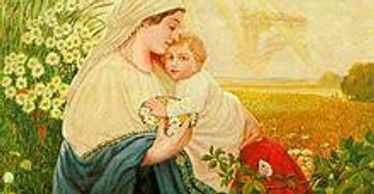
Hitler's painting of Jesus and Mary
uring the rise of National Socialism in Germany, Adolf Hitler and Nazi theologians promoted an image of Jesus that reflected Aryan racial ideals—blond-haired, blue-eyed, and detached from Jewish identity. While some accepted this portrayal at the time, and a few continue to believe it today, this reconstructed figure bears little resemblance to the Jesus described in the Christian Scriptures. The effort to present Jesus as a Gentile rather than a Jew required significant theological revision and historical distortion. In reshaping Jesus to fit Nazi ideology, essential elements of the Christian faith were systematically removed.
The New Testament consistently situates Jesus within a Jewish historical and religious context. According to the Gospels, his family traveled to Bethlehem in response to a Roman census. He was born in humble conditions and later taken to Egypt to escape King Herod’s persecution before returning to live among the Jewish people. The Gospel accounts trace his lineage to Jewish ancestors and portray him participating in Jewish customs, teaching in synagogues, and referencing Hebrew Scripture. From birth to ministry, Jesus is presented as deeply rooted in Jewish tradition. To detach him from that heritage is to disregard the narrative framework of the New Testament itself.
Alfred Rosenberg
Christian Youth groups banned by Hitler
Alfred Rosenberg
Alfred looks a little scared. True, he was afraid of a cervical dislocation, but he always knew he would end up as worm chow.
This is Alfred Rosenberg, a long-time associate of Hitler and a member of the National Socialists party prior to Hitler. He wrote the book "The Myth of the 20th Century" which is soaked in hate of Christianity. Ten years later he shared his beliefs of a new German Nationalist Church which was leaked to President Roosevelt of the United States. Roosevelt read it to United States-big mistake for the Nazis. People no longer believed Hitler was a Christian.
https://reader.library.cornell.edu/docviewer/digital?id=nur00773#mode/1up
Point 1: “The National Reich Church of Germany categorically claims the exclusive right and the exclusive power to control all the churches within the borders of the Reich; it declares these to be national churches of the German Reich”.
Point 2: “The German people must not serve the National Church. The National Church is absolutely and exclusively in the service of but one doctrine: race and nation”.
Point 3: “The field of activity of the National Church will expand to the limits of Germany’s territorial and colonial possessions”.
Point 4: “The National Church does not force any German to seek membership therein. The National Church will do everything within its power to secure the adherence of every German soul. Other churches or similar communities and unions particularly such as are under international control or management cannot and shall not be tolerated in Germany”.
Point 5: “The National Church is determined to exterminate irrevocably and by every means the strange and foreign Christian faiths imported into Germany in the ill-omened year 800”.
Point 6: “The existing churches may not be architecturally altered, as they represent the property of the German nation, German culture, and to a certain extent the historical development of the nation. As property of the German nation they are not only to be valued but to be preserved”.
Point 7: “The National Church has no scribes, pastors, chaplains, or priests, but National Reich orators are to speak in them”.
Point 8: “The National Church services are held only in the evening and not in the morning. These services are to take place on Saturdays with solemn illumination” .
Point 9: “In the National Church German men and women, German youths and girls will acknowledge God and His eternal works”.
Point 10: “The National Church irrevocably strives for complete union with the state. It must obey the state as one of its servants. As such it demands that all landed possessions of all churches and religious denominations be handed over to the state. It forbids that the future churches should secure ownership of even the smallest piece of German soil or that such be ever given back to them. Not the churches conquer and cultivate land and soil but exclusively the German nation, the German state”.
Point 11: “National Church orators may never be those who today emphasize with all tricks and cunning, verbally and in writing, the necessity of maintaining and teaching Christianity in Germany. They not only lie to themselves but also to the German nation, goaded by their love of the positions they hold and the sweet bread they eat.”
Point 12: “National Church orators hold office as government officials under civil service rules”.
Point 13: “The National Church demands immediate cessation of the publishing and dissemination of the Bible in Germany as well the publication of Sunday papers, pamphlets, publications, and books of religious nature”. Point 14: “The National Church declares that to it, and therefore to the German nation, it has been decided that Fuehrer’s Mein Kampf is the greatest of all documents. It is conscious that this book not only contains the greatest, but that it embodies the purest and truest ethics for the present and future life of our nation”.
Point 15: “The National Church has to take severe measures in order to prevent the Bible and other Christian publications being imported into Germany”. Point 16: “The National Church has made it its sacred duty to use all its energy to popularize the coeternal Mein Kampf and to let every German live and complete his life according to this book”.
Point 17: “The National Church demands that further editions of this book, whatever form they may take, be in content and pagination exactly similar to the present popular edition”.
Point 18: “The National Church will clear away from its altars all crucifixes, Bibles, and pictures of Saints”.
Point 19: “On the altars there must be nothing but Mein Kampf (to the German nation and therefore to God the most sacred book) and to the left of the altar a sword”.
Point 20: “The National Church speakers must during the National Church services propound this book to the congregation to the best of their knowledge and ability”.
Point 21: “The National Church does not acknowledge forgiveness of sins. It represents the standpoint which it will always proclaim that a sin once committed will be ruthlessly punished by the honorable and indestructible laws of nature and punishment will follow during the sinner’s lifetime”.
Point 22: “The National Church repudiates the christening of German children particularly the christening of water and the Holy Ghost”.
Point 23: “The parents of a child must take only the German oath before the altar. This oath is worded as follows: The man: “In the name of God I take this Holy oath that I (name), the father of this child, and my wife, are of proven Aryan descent. As a father I agree to bring up this child in the German spirit and as a member of the German race.” The woman: “In the name of God I take this Holy oath that I (name) bore my husband a child and that my husband is the father of this child and that I its mother am of proven Aryan descent. As a mother I swear to bring up this child in the German spirit and as a member of the German race.” The German diploma can be issued only to newly born children on the strength of the German oath”.
Point 24: “The National Church abolishes confirmation and religious education as well as the communion, the religious preparation for the communion. The educational institutions are and remain the family, the schools, the Hitler Youth, and the Union of German Girls”.
Point 25: “In order that school graduation of our German youth be given an especially solemn character, all National Churches must put themselves at the disposal of German youth. The Hitler Youth day will be on the Friday before Easter. On this day only the leaders of these organizations may speak”.
Point 26: “The marriage ceremony of German men and women will consist of taking an oath of faithfulness and placing the right hand on the sword. There will not be any unworthy kneeling in National Church ceremonies”.
Point 27: “The National Church declares the tenth day before Whitsunday to be the national holiday of the German family”.
Point 28: “The National Church rejects the customary day of prayer and atonement. It demands that this be transferred to the holiday commemorating the laying of the foundation stone of the National Church”.
Point 29: “The National Church will not tolerate the establishment of any new clerical religious insignia”.
Point 30: “On the day of its foundation the Christian cross must be removed from all churches, cathedrals, and chapels within the Reich and its colonies, and it must be superseded by the only unconquerable symbol of the Hakenkreuz (swastika)”.
Site Content

Underlying delusions
Underlying cause fallacy:
Wow, Whoopi: "He didn't like Catholics " Of course, Whoopi is correct, but that is hardly the underlying cause of his hatred. dislikeThe book on Hitler's personality states his likes and dislikes. This analysis was a part of OSS records (Office of Strategic Services, a precursor to the FI). It is based on Mein Kamph and various people who had significant interactions with Hitler. Per Murray:" Most of Hitler's sentiments are well known and have already been listed: "his high valuation of power, glory, dictatorship, nationalism, militarism, and brutality; and his low valuation of weakness, indecision, tolerance, compassion, peace, rational debate, democracy, bolshevism, materialism, capitalism, the Jewish race, Christianity." http://reader.library.cornell.edu/docviewer/digital?id=nur01134#page/29/mode/1up (21-22) Murray
I'm sure some atheists dislike Catholics, but it is laughable to think they would kill anyone. Hitler was a cesspool of underlying causes.
Hitler handles frustraTIONS
Was Hitler an emotionally even even-keeled person? From the book "Analysis of The Personality of Adolf Hitler," Not really; he had problems other than his dislike of Catholics.
Per Murray, he had "emotional outbursts, tantrums of rage and accusatory indignation ending in tears in self-pity; succeeded by periods of inertia, exhaustion, melancholy, and indecisiveness (accompanied sometimes by hours of acute dejection and disquieting nightmares) leading to recuperation; and finally, confident and resolute decision to counter-attack with great force and ruthlessness. The entire cycle may run its course in 24 hours, or it may be weeks before the aggressive decision of the third stage is reached."
http://reader.library.cornell.edu/docviewer/digital?id=nur:01134#page/22/mode/1up (15)
I must agree he was a little bit moody.
But that's not all. "Hitler is a victim of temper tantrums which have increased in intensity and frequency during the last 10 years. Atypical seizure consists of one pacing, shouting, cursing, blaming, accusations of treachery and betrayal; to weeping an exhibition of self-pity; and then falling on the floor, foaming at the mouth, and biting the carpet. The man has some control over these epileptic form attacks, using them to get his own way with his close associates."(88) Biting the carpet? Perhaps his diet was low in fiber.
Murray describes hysterical dissociation:dissociation: " He experience periods of , violent emotional outbursts, visions of hallucinatory clarity."
http://reader.library.cornell.edu/docviewer/digital?id=nur:01134#page/32/mode/1up (25) Too much coffee?
Need for Sadism (Marquis de Sade)
In his Hitler analysis, Murray brings up Marquis de Sade; I don't believe this is fair to de Sade. De Sade usually connected violence with sex, and Hitler took pleasure and relief from more disgusting violence and torture. Murray gives examples."Although the will to power is the central principle, fused with it is a vindictiveness which takes pleasure in the painful humiliation of his adversaries." Also, "The purge of 1934, the anti-somatic atrocities, the unspeakable crimes committed in Poland, these in many other actions executed or ordered by Hitler demonstrate the extent of his sadism and revengefulness.
http://reader.library.cornell.edu/docviewer/digital?id=nur01134#page/2/mode/1up page 176-77
Add to these sadistic characteristics, both hysterical dissociation and all the symptoms of paranoid schizophrenia it is safe to say he had some mental health issues as some of his underlying issues.
This type of pleasure was common amongst the Nazis, and they didn't learn this from the "Sermon on the Mount."
Site Content

Mephitic, malodorous meteorism as an underlying cause: methane madness.
He had a way with the ladies. But when he heated things between the sheets, they took the honorable way out: suicide. It's easy to blame guns, but it was quick and gave immediate relief from methane toxicity.
One of the three closest girls in his life survived ten years after the attempt.
Dr. Koster's antigas pills: take 12 a day, and don't see me in the morning.
I'm not making this up; well, I'm making up the "don't come back and see me in the morning. In all seriousness, the strychnine in those pills might not have killed him, but they didn't help.
Site Content

Madman Marty Bormann
"like naïve Christians and their spiritual opportunists, a human type being, who sits around somewhere in the sphere.... " Marty that's just mean.
Equivocation Fallacy
Overbearing, Bormann was the number two Nazi in Germany. Information went from Adolf and through Marty to the government. The letter below went to 42 gauleiters (similar to governors in the United States). Lord, God, and Almighty meant one thing to Christians but something different to Hateful Hitler and the Nazis. Below is a letter written on June 7, 1941.
"When we National Socialists speak of a belief in God, we do not understand by GodGod, like naïve Christians and their spiritual opportunists, a human type being, who sits around somewhere in the sphere...
"The force of natural law, with which all these innumerable planets move in the universe we call the Almighty or God. The claim that this world force ...can be influenced by so-called prayers or other astonishing things is based upon a proper dose of naivete or on a business shamelessness.
"As opposed to that, we National Socialists impose on ourselves and demand to live naturally as much as possible, i.e., biologically. The more accurately we recognize and observe the laws of nature and of life, the more we adhere to them, so much the more do we conform to the will. of the Almighty. The more insight we have into the will of the Almighty, the greater will be our successes."
http://reader.library.cornell.edu/docviewer/digital?id=nur00771#mode/1up
Maybe misleading Marty got up on the wrong side of the bed. The terms God, Lord, and the Almighty can be ambiguous. Their beliefs were similar to pantheism (the universe is God).
About the "live as much as possible, i.e., biologically," were you thinking this when you took cyanide, or were you conforming "to the will of the Almighty." How nice of the Russians to acclimate you to your future abode.
Site Content

equivocation Fallacy You can call a dog a cat
- You can call something anything you want; for instance, you may call a dog a cat, and they do have some common characteristics. For example, both have a tail and four legs, both will eat cat food, and both can wear a collar. In today's world, however, you might even make people believe the dog is a cat. It doesn't matter, however; the dog is still a dog, and it is an equivocation fallacy.
Hitler painted a blond-haired, blue-eyed Jesus, and some people then and now believe it. But the baby in the painting is not Jesus of the Christian faith, and the mother was per Hitler, a Greek woman with a Roman soldier husband. Call the baby what you want, but a gentile Jesus is n not the Jesus of the Christian faith. It is absurd.ts like trying to put a square peg in a round hole; it is awkward and does not make sense.
- A Roman soldier's family traveled to Bethlehem for a Jewish census.
- The soldier's son was born in a barn.
- The family moved to Egypt for three years for safety from the Roman government.
- Instead of raising the baby in Rome, they preferred to raise Jesus with Jews.
This list could go on and on, but the Blonde-haired, blu-eyed Jesus is not the Christian Jesus.
To make this blue-eye, blond-haired Jesus, the Nazis made a few changes to the Christian Bible.
- The Old Testament was for Jews only. It was removed from Bible. This eliminated 39 books.
- Remove Mathew and Luke. Both show Jesus's Jewish lineage. This eliminated two books.
- Remove Hebrews. It lists the historical heroes in the Old Testament. This eliminated one book.
- Remove the books written by the apostle Paul. Paul makes it clear that he was a Jew. This eliminates 13 books: Romans, 1 Corinthians, and 2 Corinthians; Galatians; Ephesians; Philippians; Colossians; 1 Thessalonians and 2 Thessalonians; 1 Timothy and 2 Timothy; and Titus.
- Remove 283 direct quotations from the Old Testament found in the New Testament.
- Removed 131 of 678 verses from Mark; removed 129 of 890 verses in John; removed 231 of 1006 verses in Acts; removed 51 of 108 verses in James; removed 86 out of 166 verses in Peter 1 and 2; removed 131 verses in John 1, John 2 and John 3; removed 17 of the 25 verses in Jude; nearly all the verses in Revelations. Everything in the Bible related to Jews was eliminated.
As crazy as this is, there were groups of people during Hitler's time who accepted the gentile Jesus, and people today have similar beliefs. These people believe they have an idea of Christianity but are an example of the Dunning-Kruger fallacy.
Site Content

Germany was 90% Christian
Hitler needed support from a country that was 90% Christian. In the earlier part of his career, Hitler's solution was to pretend he was Christian until he gained total power. In 1935 he used the picture to prove his Christianity. Although not a fallacy, pictures have more of an effect on people than writing, which was the reason for the image. The picture on the left was in Heinrich Hoffman's collection in 1935 but doctored for the 1938 edition.
Hitler's Religion.The Twisted Beliefs That Drove the Third Reich page 68-69
In a speech in 1922, while running for a government position, he said: "My feeling as a Christian points me to my Lord and Savior as a fighter. It points me to the man, who, once in loneliness, surrounded only by a few followers, recognized these Jews for what they were and summoned men to fight against them and who, God's truth! Was greatest not as a sufferer but as a fighter. In boundless love as a Christian and as a man, I read through the passage which tells us how the Lord at last rose in His might and seized the scourge to drive out of the Temple the brood of vipers and adders. How terrific was his fight against the Jewish poison? Today, after two thousand years, with deepest emotion I recognize more profoundly than ever before the fact that it was for this that He had to shed his blood upon the Cross. As a Christian, I have no duty to allow myself to be cheated, but I have the duty to be a fighter for truth and justice. And as a man, I have the duty to see to it that human society does not suffer the same catastrophic collapse as did the civilization of the ancient world some two thousand years ago—a civilization that was driven to its ruin through this same Jewish people." Let's look at this story.
Site Content

The gentile Jesus is an equivocation fallacy and a lie
This image is from a German school book in Nazi Germany. The blond-haired woman is telling how the Jews killed Jesus. As mentioned earlier is absurd. Yet, today in the United States, churches that believe Jesus was a Gentile still exist. Even the Southern Poverty Law Center reports these churches as Christian in name only.
There are well over 200,000 churches in the united states and nine groups of Christian Identity Movement groups. This does not matter to some people; they respect Hitler's honesty and refuse to believe in a Jewish Jesus. After all, has there ever been a better theologian?
Well over 99% of terrorism blamed on Christians in the United States is associated with the Gentile Jesus
Positive Christianity
What is positive Christianity? It ain't positive, and it ain't Christian. Its primary tenants are:
- " It fights against Jewish materialistic spirit at home and abroad and believes that any lasting recovery of our people must be based on the spiritual principle: the welfare of the community comes before that of the individual."
It doesn't sound positive to me, and the belief that Jesus was bizarre. Think about it
- A Roman soldier's baby was born in a feeding trough in a barn.
- The Roman family had to hide in Egypt for three years for fear the Roman Government would kill the baby.
- The Roman family that hated Jews decided to live among the Jews and send their son to learn Judaism. Bizarre and Christian in name only.
The Reich Church
Hitler and the Nazis initially encouraged this church, which believed in the Gentile Jesus. They hoped to combine Gentile Jesus Churches and Jewish Jesus Churches. The Nazis were allowed to attend the Reich Church, but not the other. The blogosphere is filled with photos in the Reich Church and were used as a propaganda. At the time it was helpful to the Nazis and today many people are unaware of the difference.
Site Content
Guilt by association
Look, they are BFFs. Of course, they are! I wouldn't call Hitler and Reich Bishop Ludwig Mueller friends, but they did know each other, and Hitler did not kill him. Lud was a Gentile Jesus believer, a leader in the Reich Church, and was rewriting the Bible to fit his beliefs.
The smiling Ludwig Muller actually won his position as Reich Bishop by-election ( actually, he came in second). . Friedrich von Bodelschwingh won the election but resigned for some reason. Hitler was the "reason," and Ludwig, who believed in a blue-eyed, blond-haired Jesus, was not surprisingly appointed. This was on July 20, 1933.
Within a couple of months, the destruction of the churches began. You can read the entire 92-page document prepared for the Nuremberg trials or read my quick summary at the end of this page.
Site Content
Do aCTIONS SPEAK LOUDER THAN words?
One of the most famous photographs of Hitler and is used as proof that Hitler was a Christian and the Christian Church was in cahoots with the Nazis to spread hate and violence. This faulty logic is called guilt by association. The photograph was used to fool people, it did so, and more today than ever before. The supposed protestant minister's (he believed in the blue-eyed blond-haired Jesus) primary purpose was to mix the churches with National Socialism. It did not work.
The photograph was taken in 1933 to celebrate Hitler's increased power. Mueller, the man, shaking hands with Hitler, was handpicked by Hitler. His beliefs were identical to Hitler's, and his job was to convert Germans into one new religion, which was a mixture of Hitler's religious beliefs and German Nationalism. That is why many photographs and pictures with Christian symbols and National Socialists Symbols mistakenly give the impression the two were working together. They were not. Below is a quick summary of Hitler's actions after the photograph.
Since 2017, the world has had access to thousands of pages of information collected by the Office of Strategic Services (O.S.S.), the precursor to the C.I.A., used against the Nazis during Nuremberg. https://lawcollections.library.cornell.edu/nuremberg/catalog/nur:00773 "S.R. &3114.4/
The Nazi Master Plan/ Annex 4: The Persecution of the Christian Churches / Office of Strategic Services / Research and Analysis Branch / Draft for the War Crimes Staff/ Approved by the Prosecution Review Board / CONFIDENTIAL." it is just over 90 pages. Although just a summary of the Nazi's actual beliefs. Below is a quick summary of the 90-page document. The numbers at the end of the reference are the page number in the document.
- Germany intended to convert the country into a homogenous group for aggressive warfare. This required complete extirpation of Christianity and replacement with a purely racial religion tailored to fit the Nazi Party. (5,6)
- Within a couple of months of the Concordat signing, the 700,000 Evangelical Youth Group was dissolved. The new leader of the youth on November 5, 1934, was announced: Balder Von Schreck ( a staunch atheist with hate toward Christianity). So far as this sector of the National Socialist party is concerned, the destruction of Christianity was explicitly recognized as a purpose of the National Socialist Movement". (6)
- The Nazis intended to remove any influence of churches as much as possible. This had to be done by slow and gradual encroachment and encouragement of the Positive Church. (7,8)
- Hitler, Rosenberg Goring, Goebbels, Hess, Baldur von Schirach, Frick, Rust, Kerrl and Schemm were the main Nazis in planning the extirpation.
- There always existed a poor relationship between the Nazi party and the churches. This relation became dramatically worse as the Nazis gained power.
- The Concordat legally guaranteed the Nazis would not interfere with the church. In reality, except for the Positive Church, they destroyed the churches. (19)
- Most members of the Jehovah's Witnesses and Pentecostal churches were placed in concentration camps. (26)
- The S.A. and Hitler Youth were used to interfere with the churches. This included the destruction of property, intimidation, and physical force. (29)
- The Nazis took over control of the German Evangelical Church. The German Christian was another name for the Positive Church. (30)
- Nazis took over the Norway Christian Churches and the entire Norwegian pastorate; with insignificant exceptions, all of the Norway Christian church leaders resigned on Easter 1942. (31)
- Smaller denominations were shut down quickly by directly attacking members personally: refusing peddler's license, refusing a permit to practice as a midwife, dismissal of a postal clerk, refusal of the right to worship in the home, removal of children from home. (33)
- In Nov 1934, churches could be deprived of all financial support at the hands of the Nazis. (35)
- In 1935 bishops of the Catholic Church were notified that their correspondence and telephone calls were subject to constant surveillance by the church. (36) Numerous times, Nazis did this. (35)
- Reich Bishop Muller removed Dr. Niemoller from his pastorate German Evangelical Church. (36)
- Although the Nazi policy wanted to make criminals, not martyrs, out of Christians inside Germany, they did murder Klausener, Beck and, Probst in 1934. ( 41)
- Large numbers of Catholic Priests were murdered in Poland. (41,42)
- Looting, demonstrations, destroying church property, private offices, and physically threatening Bishop Dr, Sproll of Rottenberg occurred on several occasions by the S.A. and the Hitler Youth. This happened in 1938. (42)
- In 1935 Hitler Youth attempted to overturn the car of Archbishop Klein and spat on him. (46)
- After a political meeting ended in November 1938, a uniformed detachment arrived at the residence of Cardinal Faulhaber and started destroying his house and shouting, "Take the rotten traitor to Dachau." (47,48) This type of behavior continued for years. (48)
- On October 8, 1948, the Nazis looted and damaged Cardinal Innitzer's residence and the episcopal chapel. In the process, a secretary was knocked unconscious. (49)
- In Vienna, October 7, 1938, Hitler Youth and the S.A. demonstrated singing "Down with Innitzer. Our Faith is Germany" (50)
- On October 15, 1938, a mob broke into the Cathedral Curia in Vienna, destroyed property, and threw the priest out the window. (50)
- In June 1938, Cardinal Innitzer was attacked with rotten eggs, potatoes, and umbrellas. (51)
- In 1933 a nazi official, Bishop Wurm of Wurttemberg, and Bishop Meiser of Bavaria were put under house arrest. (52)
- In September 1943, a prominent protestant was arrested by the Gestapo. (52)
- In January 1937, nine pastors were arrested by the secret police. (52)
- On July 1, 1937, Pastor Martin Niemoller was put in prison. He spent eight months in jail when charges were dismissed, and he was freed. Upon leaving, the Gestapo arrested and placed him in a concentration camp until the Nazis surrendered.
- In May of 1935, a prest of Koblenz-Neuendorf was put in prison. (53)
- In May 1936, a priest in Mannhein was imprisoned for four months for speaking critically of the Hitler youth. (54)
- On April 16, under the guise of spiritual advice, supporters of the anti-Christian movement tricked the Parish priest into saying something negative about Rosenberg's book "The Myth of the Twentieth Century" Rosenberg was a Nazi atheist ideologue. Who created the Positive church. In Nazi Germany, saying something negative about an atheist resulted in one and half years in prison(54)
- On July 22, 1937, he was sentenced to six months in jail for preaching. (54)
- The O.S.S. had limited information on the persecution of Christianity in Poland at that time. However, reports of imprisonment of large numbers of Christian leaders were reported. (56) Although the O.S.S. did not have the information, we now know Hitler slaughtered vast numbers of priests and nuns.
- The O.S.S. had minimal information on persecution of churches in Norway but had reports of many associated with the church being imprisoned. (56)
- in 1938, the Bishop of Rottenberg lost his job for failing to vote in the election in April. (57)
- In 1938 priest protested a denominational school's conversion into a Nazi community school and lost his job. (57)
- In 1938, many Polish churches were closed, sealed, or used as warehouses by the Germans. (59)
- In 1937 German Government-imposed censorship of church literature and periodicals and forced the cessation of virtually all church periodicals. Some of the printing companies were closed for publishing. The brave Nazis were able to take into custody seven Catholic girls for distributing print materials. (62)
- In 1939 churches were not allowed to read the Encyclical by Pius XII.(63)
- Numerous confiscation of written materials from the churches. (63-67)
- Rosenberg, Hitler's right-hand man, demanded the Germans give up the Christian faith. Papers written by pastors to protest his demand were confiscated. (67)
- When pastors read a manifesto against Alfred Rosenberg from their pulpits, 700 were arrested, and some were put in concentration camps. (67)
- Closing the theological school at the University of Munich in May 1939. (69)
- All seminaries in Austria were closed. (69)
- In 1938 the theological seminary department at the University of Innsbruck, Canisiamm, and Salzburg was closed. (70)
- In March of 1944, the last theological school was closed. (70)
- All religiously affiliated elementary and high schools in Germany were closed by 1940. (71-76)
- In April 1935, all public activities of the Jesuits were stopped. All private activities of the Jesuits were to be monitored in Germany. (78 -79)
- "In 1939, the Missions Institute of St. Ruprechtin Kreuzberg (Salzburg) was dissolved by the Nazi authorities. The three houses of the "Society of Christ the King" in former Austrian territory were closed and its property confiscated. In the same year, the old Austrian 'Abbeys of Goettweig, Admont, and Engelszell were also appropriated. The Government took over all the leased property of the foundation of Klosterneuburg near Vienna. The Feldkirchner Hof, a hostel of the Sisters of the Holy Cross in Feldkirchen near Klagenfurt was also confiscated by the Gestapo".(81)
- All 700,000 Christian youth groups not associated with catholic youth groups were placed in Hitler Youth groups. Balder von Scherick stated: "The Hitler Youth will not compromise but will go on its own way, which must necessarily lead to the destruction of all other youth organizations." Quote from Koelnische Volkszeitung, January 14, 1934. (83)
- Balder von Schrick stated: "The incorporation of the Protestant Youth associations will some time or other be followed, and necessarily followed by that of the Catholic Youth at a time when all are abandoning their private interests, Catholic youth no longer have any right to lead a separate existence." Quote Schesisasche Volkszeitung March 29, 1934 (83)
- Dr. Werner was a Nazi collaborator who was put in place to control the Christian Churches. "On March 8, 1938, all the provincial churches were forbidden by Werner to make any regulations except in matters of faith or worship without his consent." Clearly, this was one of the principal agencies of National Socialist control over the Gerrman Evangelical. Church." (87)
- "Reich propaganda Ministry was a chief agency for the control of Nazi propaganda. It bears chief responsibility for the systematic campaign of defamation waged against the German clergy. It was also the direct agency for the issuance of certain orders for the censorship of Church publications. Sections or 'persons, particularly for carrying out this phase of the work of the Ministry cannot be determined here." (88)
- The Gestapo was used in all aspects of church persecution. (89)
- The S.S., S.A., and Hitler Youth were all used for the persecution of the churches. The Hitler Youth were employed in breaking up Christian Youth Movements and their indoctrination. (90)
- Although the churches' persecution was most severe in Norway and Poland, the people responsible could not be determined for the Nuremberg Trial. (90),
The brave Nazis released the seven Catholic girls who distributed church materials; weren't they kind?http://reader.library.cornell.edu/docviewer/digital?id=nur:01562#page/16/mode/1up
- Borman declared that confiscated property from the churches in monasteries belonged to the Reich. Schirach insisted on no compensation for the properties.(16)
- Schirach received a letter from the dean of theological faculty in Vienna reporting persecution of the Catholic priests. (16)
http://reader.library.cornell.edu/docviewer/digital?id=nur:00541#page/61/mode/1up
